
Minnesota taxes estates on its own terms. The state sets its own exemption, runs its own rate schedule, and, unlike the federal government, does not let a surviving spouse pick up whatever exemption the first spouse left unused. For a married couple whose combined estate sits at or above $6 million, that last point is the one that costs families money.
A lake property that has appreciated for thirty years, a business built from nothing, a pension and a couple of retirement accounts: none of it has to be extravagant to add up to $6 million between two people. And once it does, the order in which assets pass at the first spouse's death determines whether the family uses one Minnesota exemption or two.
A credit-shelter trust, also called a bypass trust, is the tool most commonly used to make sure both exemptions get used.
Minnesota's $3 Million Exemption, and Why Portability Doesn't Apply
Every Minnesota resident who dies with a taxable estate gets a $3 million exemption before the state estate tax applies. Amounts above that threshold are taxed on a graduated scale, from 13% up to 16%. That much is well known.
What catches people off guard is what happens to the exemption of the spouse who dies first. At the federal level, an unused exemption can transfer to the surviving spouse through an election called portability. Minnesota has no equivalent rule. If the first spouse's assets pass outright to the survivor, as they typically do without planning, that spouse's $3 million Minnesota exemption simply disappears.
The federal exemption, by contrast, now sits at $15 million per person for 2026 under the One Big Beautiful Bill Act. Most families never think twice about federal estate tax anymore, and that is exactly the problem. A couple can be well below the federal threshold and still owe a meaningful Minnesota estate tax bill, because the two systems do not share a floor.
The Cost of Doing Nothing
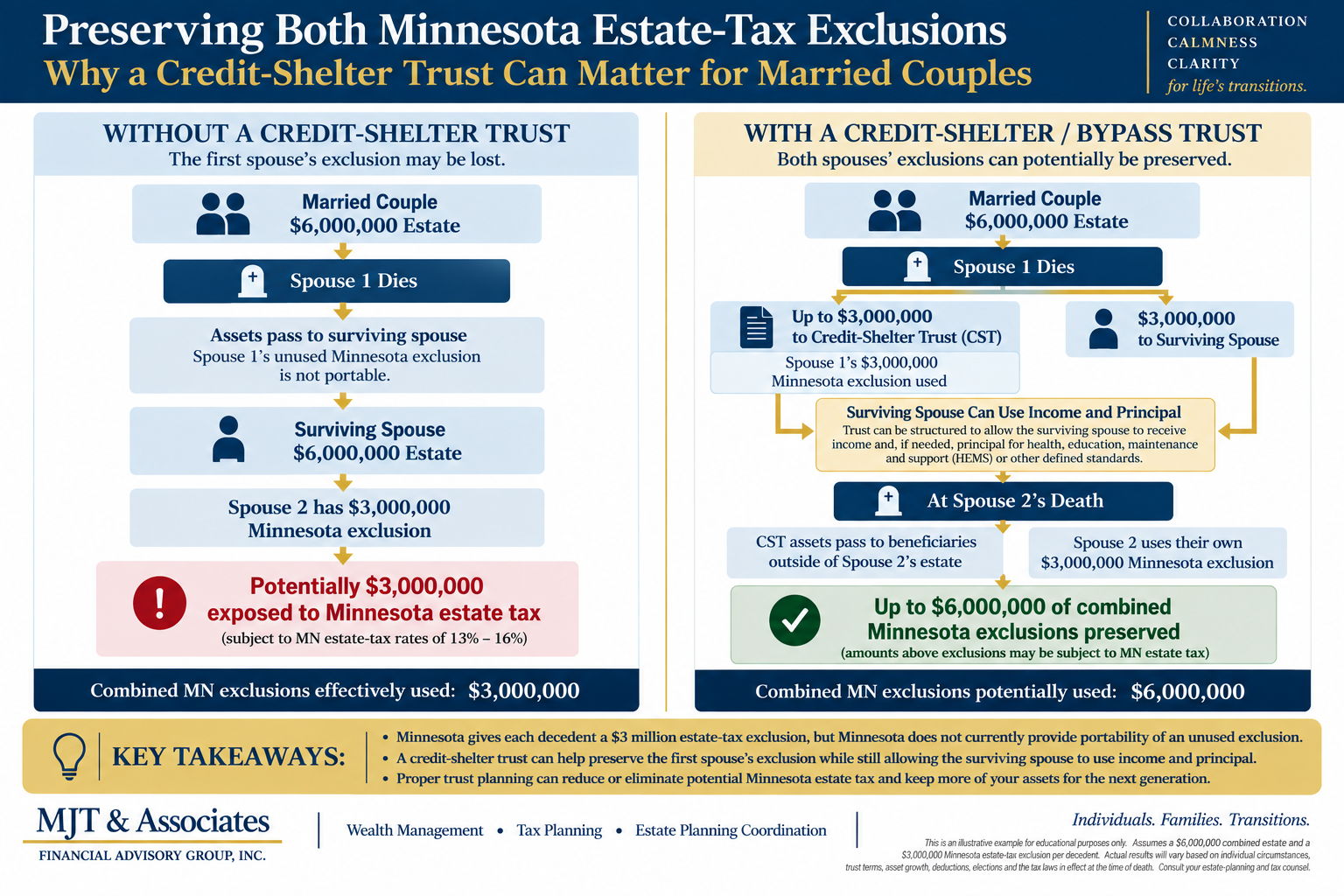
Consider a married couple with a combined $6 million estate and no credit-shelter trust in place.
- The first spouse dies. Assets pass outright to the surviving spouse, as most beneficiary designations and joint ownership arrangements are set up to do.
- The first spouse's $3 million Minnesota exemption goes unused, and because Minnesota does not allow portability, it cannot be recovered later.
- The surviving spouse now holds the full $6 million estate but has only their own $3 million exemption available.
- At the second death, $3 million of the estate is exposed to Minnesota estate tax at rates of 13% to 16%, a bill that could have been avoided.
The couple in this scenario effectively used only $3 million of combined exclusion, half of what was available to them.
How a Credit-Shelter Trust Changes the Outcome
With a properly drafted and funded credit-shelter trust, the same $6 million estate plays out differently.
- At the first spouse's death, up to $3 million funds the credit-shelter trust, using that spouse's Minnesota exemption before it can be lost.
- The remaining $3 million passes to the surviving spouse outright, or into a separate marital share.
- The trust can still be structured so the surviving spouse receives income, and principal for health, education, maintenance, and support, often referred to as the HEMS standard. Access to the money does not have to disappear along with the tax exposure.
- At the second spouse's death, the trust assets pass to the couple's beneficiaries outside the surviving spouse's taxable estate, and the surviving spouse's own $3 million exemption covers what remains in their name.
- Up to $6 million in combined Minnesota exclusions is preserved, doubling what a couple can pass free of state estate tax compared with no planning at all.
The mechanism only works if the trust is actually funded at the first death. A trust that exists on paper but never receives the assets it was designed to hold accomplishes nothing.
Who This Matters For
This is not a strategy reserved for the ultra-wealthy. Around Lake Minnetonka and the broader Excelsior area, it is common for a couple's home and lake property alone to push a combined estate past $3 million, before a business interest, a 401(k), or a life insurance policy is even counted. Families who think of themselves as comfortable, not wealthy, are often the ones most exposed, because they have never had a reason to think about estate tax at the federal level and assume Minnesota works the same way.
Business owners face a related wrinkle. Minnesota offers an additional deduction of up to $2 million for qualifying farm and small business property, on top of the standard $3 million exemption, but the qualification rules are specific and worth reviewing with an estate planning attorney well before a sale or transition is on the table.
Getting the Structure Right
A credit-shelter trust is a legal document, but the planning around it is where a financial advisor adds the most value.
- Asset titling has to match the plan. Jointly held property and beneficiary designations that name the surviving spouse directly will bypass the trust entirely, regardless of what the trust document says.
- Trustee selection matters. The trustee controls distributions to the surviving spouse under the HEMS standard, so the choice of trustee, whether a family member, a corporate trustee, or both, should reflect how much flexibility the couple wants built in.
- The math should be modeled, not assumed. Whether $3 million is the right funding amount depends on the estate's total value, its likely growth, and whether the farm or small business deduction applies.
- Minnesota has no gift tax, and annual gifts up to the federal exclusion of $19,000 per recipient in 2026 reduce a taxable estate over time. Gifts made within three years of death, however, can be pulled back into the Minnesota estate, so timing has to be intentional rather than reactive.
Frequently Asked Questions
Q1: We are well under the federal estate tax exemption. Do we still need to worry about this?
Yes, and this is the gap most families miss. The federal exemption is $15 million per person in 2026. Minnesota's exemption is $3 million per person, with no connection to the federal number. A couple can owe nothing federally and still owe a substantial Minnesota estate tax bill.
Q2: My spouse already passed away and we never set up a credit-shelter trust. Is that exemption gone for good?
In most cases, yes, once the first spouse's assets have passed outright and the estate has been settled. This is exactly why the planning needs to happen while both spouses are living, not after the fact. If you are in this position, it is worth a conversation about what planning options remain for your own estate.
Q3: Will my surviving spouse actually be able to use the money in the credit-shelter trust?
Yes, when the trust is drafted with that in mind. A well-structured credit-shelter trust allows the surviving spouse to receive income and, when needed, principal for health, education, maintenance, and support. The assets are managed by a trustee rather than owned outright, but access does not have to be restrictive.
Q4: Our combined estate is close to $3 million but not quite there. Is this still worth doing?
It depends on the trajectory. Real estate appreciation, business growth, and retirement account balances can move an estate across the $3 million threshold faster than people expect. If your estate is approaching that level, or could reasonably grow into it over the next decade, it is worth reviewing now rather than after the fact.
Related Reading on the MJT Blog
- The Legacy Planning Checklist: 7 Documents You Can't Ignore
- Achieve Financial Wellness: The Benefits of a Holistic Financial Planner
- A Real Financial Plan: What It Includes, Why It Matters, and Where Most People Fall Short
Conclusion
Minnesota's estate tax rules reward planning and punish assumption. A couple who assumes their exemptions will simply carry over, the way the federal system allows, can lose $3 million of protection without ever realizing it was at stake. A credit-shelter trust, properly drafted and properly funded, is how married couples in Minnesota keep both exemptions working instead of one.
At MJT & Associates, we coordinate this kind of planning directly with your estate attorney, making sure the trust structure, the asset titling, and the broader financial plan are all pointed in the same direction.
Ready to review whether a credit-shelter trust makes sense for your estate? Contact us today to schedule a consultation.